
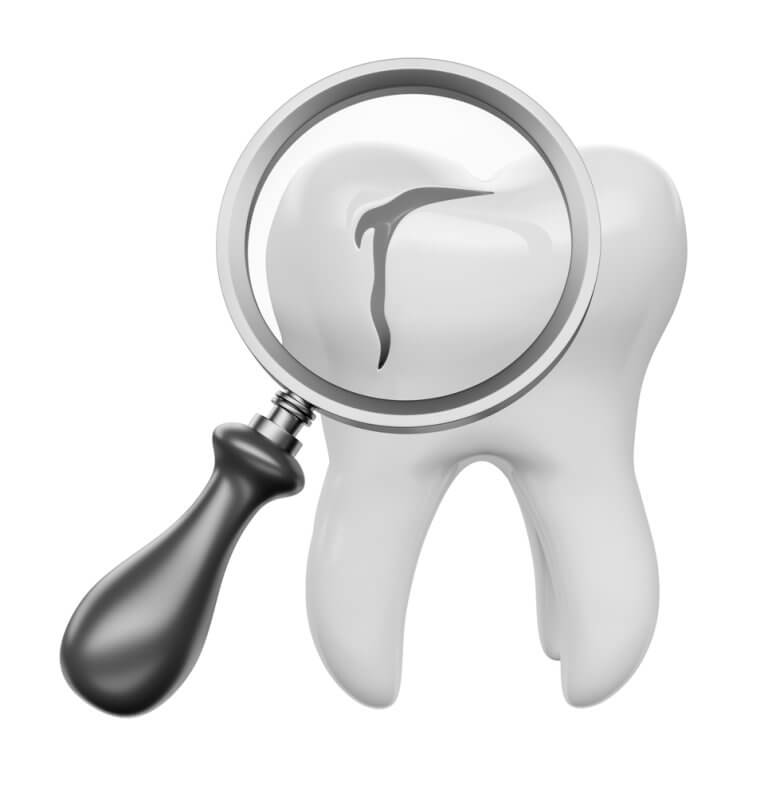
You Crack Me Up
When we use the word “crack” in the context of the title, it’s a lighthearted way of saying someone is funny. However, the word “crack” can also have a more serious meaning, such as cracking an expensive vase or a large glass window.
When we use the term in relation to dental care and teeth, it usually indicates trouble, and cracked tooth symptoms can be surprisingly difficult to diagnose.
Identifying a crack is one of the most challenging tasks I face as a dentist. Even after finding the crack, determining whether it’s actually causing your tooth pain when biting remains another challenge.
Why Cracked Teeth Are So Difficult to Diagnose
Often, when we examine teeth, we do so under magnification.
Many dentists use magnifying loupes or glasses. Dental students are trained to use these aids as part of their education.
Besides seeing my work in a magnified fashion, I see your teeth all blown up on the big screen, too. The smallest defects in teeth or fillings are larger than life to me. Much like the scene in “Gulliver’s Travels”, I have to determine if those things that I see that are larger than life are an issue or not. I often see microscopic fractures in enamel. Are these tiny cracks a cause for concern?
Common Symptoms of a Cracked Tooth
When a patient presents with a toothache, the most common cause is decay or infection.
I will often see a broken tooth or swelling. A quick X-ray confirms my visual diagnosis, and the road to recovery is straightforward. The challenge can occur when I don’t see one of those signs. Visually, there is nothing evident. If I take a radiograph, I don’t see anything, yet the patient has taken the time to come to me because something is not just right.
Common cracked tooth symptoms include:
- Pain when biting down on food
- Pain when releasing your bite
- Intermittent pain that comes and goes
- Sensitivity to hot or cold temperatures
- Discomfort that’s hard to pinpoint to a specific tooth
Sometimes the pain is there all the time, and other patients only have pain when they bite. Alternatively, the pain occurs when they release their bite.
These symptoms, among others, can result from an inflamed, dying tooth. The death process of a tooth is often associated with a variety of complaints of pain in a certain tooth. If the tooth is so severely irritated that it cannot recover, endodontic therapy, also known as root canal therapy, is often indicated.
Treatment Options: From Dental Crowns to Extraction
A couple of weeks ago, my patient came to me with a definitive toothache on his upper left first molar. It did not appear to require root canal therapy, so I diagnosed a cracked tooth and informed him that I would place a crown on the tooth. He did not need root canal treatment.
A dental crown for a cracked tooth can brace the fractured areas and resolve the issue.
That is precisely what happened. He felt great. A few days later, another tooth hurt him. That tooth also appeared normal, and I advised him to give it some time and see if it improves.
Last Saturday night, things happened. While chewing, that other tooth split in half vertically and caused him a lot of pain. When I saw him in the office, the only treatment was extraction and the placement of an immediate implant.
The Hidden Danger: Teeth Grinding and Clenching
Why was all of this happening to him? He is a severe grinder and clencher.
This habit—known as bruxism—is destroying his teeth one at a time.
Many patients clench without realizing it, which can cause significant damage and lead to cracked tooth symptoms over time.
Preventing Cracked Teeth from Grinding
If you grind or clench your teeth, especially at night, a custom night guard can protect your teeth from the extreme forces that cause cracks and fractures. Catching the grinding habit early is always best, and prevention is even better than treating cracked teeth after they’ve already caused problems.
When to See an Emergency Dentist for Tooth Pain
If you have a tooth that doesn’t feel right and is affecting your life, don’t just live with it. Tooth pain when biting, unexplained sensitivity, or intermittent discomfort could all be signs of a cracked tooth that needs immediate attention. The longer you wait, the more likely a small crack can turn into a severe fracture requiring extraction.
Please call us at 440.951.7856 and let me see if I can help you. Early diagnosis of cracked teeth can save your tooth and prevent the need for more extensive treatment. I look forward to meeting you.
Jeffrey Gross, DDS, FAGD, is an Ohio-licensed general dentist and is on the staff of Case Western Reserve School of Dental Medicine.