
A patient recently asked me a question that sounds simple but trips up a lot of people. A specialist referred him to me after placing his implant—that’s all the specialist does. He doesn’t put a tooth on top of it. When I told my patient I needed to make him a crown, he was confused. He knew about crowns that go on natural teeth. What did that have to do with an implant?
To really answer that, I need to explain the difference between three things that all get called a “crown”: a natural crown, a regular dental crown, and an implant crown. The word is the same, but the three are quite different.
What Is a Natural Crown?
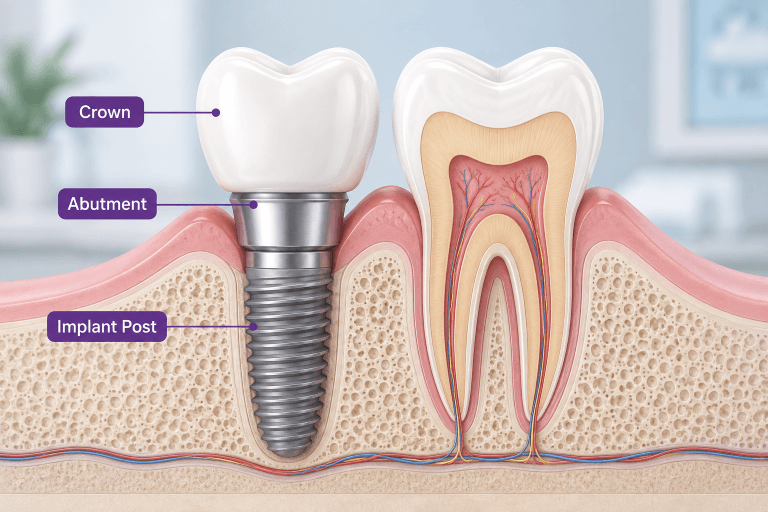
This is the part of your tooth you were born with — the part that grew in as a kid or, for your permanent teeth, as an adult. It’s the section you can see above the gumline. Enamel, the hardest substance in the human body, covers it. Underneath the enamel is dentin, and inside the tooth is the nerve and blood supply. A natural crown sits on top of a natural root, and that root is held in your jawbone by a ligament that lets the tooth flex slightly and sense pressure. You can read more about tooth anatomy from the American Dental Association.
What Is a Regular Dental Crown?
A regular dental crown is a restoration. It covers a natural tooth that’s been weakened by decay, a large filling, a root canal, or a crack. To place one, I remove some of the tooth structure to make room, then cement the crown over what’s left. The tooth underneath is still your natural tooth — root and all — it just needs protection. The crown itself is usually made from porcelain, zirconia, or another dental material, and a well-made one can look and function almost exactly like the tooth it’s covering. The ADA’s MouthHealthy resource has a good overview if you want to see how these are made.
What Is an Implant Crown?
An implant crown is used when the tooth and its root are both gone. Instead of sitting on a natural tooth, the crown attaches to a dental implant that’s been placed in the jawbone. The implant itself acts as the artificial root. A small metal connector, called an abutment, joins the implant to the crown — or in some cases, the crown has a screw built in that connects it directly to the implant. The American Academy of Periodontology has more detail on how implants integrate with the jawbone if you’d like to dig deeper. If you’re weighing whether an implant is right for you in the first place, I cover that on our dental implants page as well.
Implant Crown vs. Regular Crown: What’s Really Different
Here’s the real difference between an implant crown and a regular crown: a regular crown sits on a natural tooth. An implant crown sits on an artificial root — the implant.
That distinction matters more than it sounds. A natural tooth is surrounded by a periodontal ligament, a thin layer of tissue that cushions the tooth, senses pressure, and allows for tiny amounts of movement when you bite down. An implant doesn’t have that ligament. It’s fused directly to the bone in a process called osseointegration. So an implant crown doesn’t move or feel quite the same way a tooth on a regular crown does, even though both can look identical from the outside.
Why an Implant Crown Isn’t Just “a Crown Screwed Onto an Implant”
Patients sometimes assume an implant crown is just a regular crown attached to an implant instead of a tooth. The visible part might look nearly the same, but a lot more goes into it. When I’m designing an implant crown, I have to account for the implant’s exact position in the bone, the shape and health of the surrounding gum tissue, how the bite comes together, and how the crown connects—cemented onto an abutment or screwed directly into the implant. Get any of that wrong, and the crown can look fine but function poorly, or put stress on the implant it shouldn’t.
So What Kind of Crown Do You Have?
Next time someone tells you they have “a crown,” it’s worth asking what kind. A natural crown is the tooth you were born with. A regular crown restores a natural tooth that’s still there. An implant crown replaces the visible part of a tooth that’s already gone. All three can give you a great-looking smile and a tooth you can chew with confidently. But underneath the surface, the biology — and how that tooth or implant actually behaves in your mouth — is very different.
Questions About Your Treatment? Let’s Talk
If you’re ever unsure about a recommended treatment or just want it explained in plain language, give me a call. I’m happy to walk you through it or offer a second opinion. You can also browse more patient explainers like this one on our blog. Call my office at 440-951-7856, and I’ll do my best to help.
Key Takeaways
| • A natural crown is the visible part of your original tooth, covered in enamel. • A regular crown restores a natural tooth that’s still there, root and all. • An implant crown replaces a missing tooth’s visible portion and attaches to an implant acting as an artificial root. • Implants don’t have a periodontal ligament, so they don’t move or feel exactly like a natural tooth. • Implant crowns require careful planning around implant position, gum tissue, and bite — not just fitting a crown on top. |
Frequently Asked Questions
What is the difference between a regular crown and an implant crown?
A regular crown covers and restores a natural tooth that’s still in place. An implant crown replaces the visible part of a tooth that’s already missing, attaching to a dental implant that acts as an artificial root instead of a natural tooth.
Does an implant crown feel the same as a natural tooth?
Not exactly. A natural tooth has a periodontal ligament that allows slight movement and pressure sensation. An implant is fused directly to the bone without that ligament, so an implant crown can feel and respond a bit differently when you bite down, even though it looks the same.
What connects an implant crown to the implant?
Usually a small metal connector called an abutment joins the implant to the crown. In some cases, the crown has a screw built in that attaches it directly to the implant instead.
Can any dentist place a crown on my implant?
Placing a crown on an implant takes different planning than a regular crown. The dentist needs to account for the implant’s exact position, the surrounding gum tissue, your bite, and how the crown will attach, so it’s worth confirming your dentist is experienced with implant restorations specifically.
Jeffrey Gross, DDS, FAGD, is an Ohio-licensed general dentist with over 40 years of experience and a Fellow of the Academy of General Dentistry. He was on the staff of Case Western Reserve School of Dental Medicine and has placed and restored dental implants since the early 1990s. He practices at The Healthy Smile in Eastlake and Cleveland Heights, Ohio.