
By Dr. Jeffrey Gross, DDS, FAGD | The Healthy Smile | Eastlake, Ohio
If flossing hurts or makes your gums bleed, the problem may be your tool—not your teeth. In this article, Dr. Gross explains when a water flosser vs string floss is better and how to find the right fit for your unique mouth.
I Know What To Do, but I Just Can’t Do It!
I know what you’re thinking: “I know I should floss. I just don’t.” But today I want to talk about a slightly different problem — one I hear from patients who do floss, and hate every second of it. Because here’s something worth knowing: if flossing hurts or makes your gums bleed, the issue often isn’t your gums. It’s the tool.
One of my patients came to me recently, ready to give up on flossing altogether. His complaint? Pain — and a lot of it.
He had been using traditional string floss aggressively, and the bleeding had been spreading toward the front of his mouth. As far as he was concerned, it was string floss or nothing.
That’s when I put on my Sherlock Holmes cap.
Why Flossing Hurts (And Why That Matters)
Widespread pain or bleeding during interdental cleaning is almost always a red flag — but not the one most patients assume. Many people think painful flossing means their gums are beyond help, when in reality the technique or tool is the culprit. I never want a patient to abandon flossing because of discomfort. Cleaning between your teeth is non-negotiable for preventing decay and gum disease.
This patient had a few things working against him. He was missing some back teeth, and the teeth he did have were tightly crowded — a combination I’ve written about before. Crooked or crowded teeth trap more food and plaque, and they’re much harder to clean manually. That alone makes traditional string floss a real chore, even with perfect technique.
But he wasn’t sure the string was the actual problem, so it was time to look at the evidence.
Water Flosser vs. String Floss: What the Evidence Says
When a patient is unsure which flossing method is best for them, I break down how each tool actually works — because they’re quite different.
Traditional String Floss
String floss has been the gold standard for good reason. It physically scrapes sticky dental plaque off the sides of your teeth with mechanical friction. For patients with good manual dexterity and normal tooth spacing, it’s highly effective. The downsides? Technique matters enormously, and when used too aggressively — or in a crowded mouth — it can saw into gum tissue and cause exactly the kind of bleeding my patient was experiencing.
Water Flossers (Oral Irrigators)
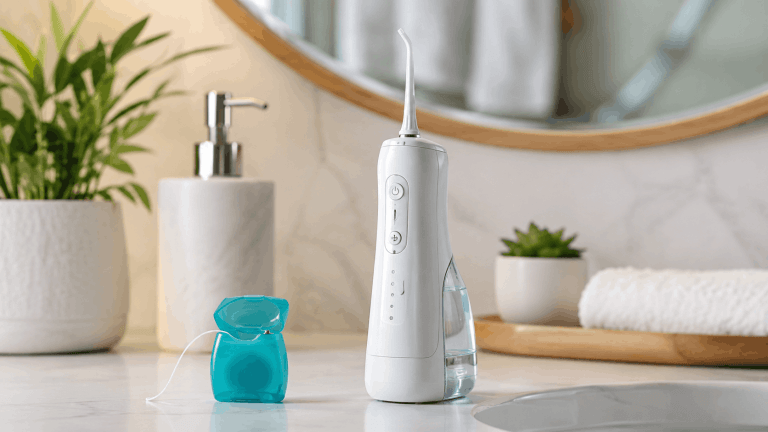
A water flosser — sometimes called an oral irrigator — works completely differently. Instead of mechanical scraping, it uses a pressurized, pulsating stream of water to flush debris and bacteria from between teeth and below the gumline. Research shows that water flossers are particularly effective at reducing gum bleeding and inflammation, making them an excellent option for patients with sensitive gums, crowded teeth, dental implants, bridges, or arthritis.
The key distinction: string floss scrapes, while a water flosser flushes. Both reduce plaque and protect your gums — they just do it differently.
| KEY TAKEAWAY: Pain while cleaning your teeth and bleeding gums are not normal in a healthy mouth with the right tools and technique. If you’re experiencing either, please don’t just push through — there’s a better solution waiting. |
Finding the Right Flossing Tool for Your Unique Mouth
Here’s what I love about practicing dentistry: there is no single “right” answer for every patient. When I switched my patient to a water flosser, the transformation was immediate. He described how much gentler it felt. The bleeding stopped. The problem wasn’t his gums — it was his tool.
Finding the right tool for the right job is fundamental to good dental care. Some of my patients have arthritis and genuinely cannot manage the hand movements required for string floss. A water flosser gives them an easy, effective alternative. Others have dental implants, bridges, or braces — situations where a water flosser reaches places string floss simply cannot.
Here’s a quick guide to help you figure out which approach might work best for you:
- String floss is generally best for: patients with normal spacing, good hand dexterity, and no sensitivity issues.
- A water flosser is often the better choice for crowded or tightly spaced teeth, arthritis or limited dexterity, sensitive or bleeding gums, dental implants, bridges, or orthodontics.
- Both tools together? Ideal for many patients — the string handles mechanical plaque removal, and the water flosser flushes out what remains.
The bottom line: oral hygiene is not a one-size-fits-all equation. Your dentist should explore all the options with you. That’s exactly what we do at The Healthy Smile in Eastlake, Ohio.
A Note on Crowded Teeth and Oral Hygiene
I’ve said it before and I’ll say it again: crowded or crooked teeth aren’t just a cosmetic issue. They create more surface area for plaque and food to hide, and they make routine cleaning genuinely harder. If you’re finding flossing difficult because of tooth alignment, that’s worth a conversation — both about your cleaning tools and about whether options like Invisalign might be right for you. Straighter teeth are simply easier to keep clean.
Don’t Live with Pain or Bleeding Gums
Here is the most important thing I can tell you: pain while cleaning your teeth and persistent bleeding are not something to accept. They are signals. Either the technique needs adjusting, the tool needs to change, or something else requires attention. Any of those is a reason to call us, not a reason to give up.
At The Healthy Smile, our mission has always been prevention over intervention. That means we want to customize your care — including something as fundamental as your flossing routine — based on your unique anatomy and situation. If this sounds familiar, please reach out. We’d love to help you find your solution.
| Ready to find the right flossing solution for your mouth? Call Dr. Gross at 440.951.7856 or visit jeffreygrossdds.com/contact-us to schedule your personalized consultation. |
Frequently Asked Questions
Is a water flosser a good alternative to string floss?
Yes — for many patients, a water flosser is an excellent alternative, and for some it’s actually the better choice. It’s especially effective for people with sensitive or bleeding gums, crowded teeth, dental work like implants or bridges, or limited hand mobility. That said, string floss is still ideal for patients who can use it comfortably and consistently. The best tool is the one you’ll actually use correctly.
Why do my gums bleed when I floss?
Bleeding gums are among the most common patient concerns I hear about. In many cases, it comes down to one of three things: technique (being too aggressive), the tool itself (string floss in a difficult anatomy), or early gum disease (gingivitis). Bleeding that persists after switching tools or improving technique is definitely worth a professional evaluation.
Can I use a water flosser if I have dental implants or a bridge?
Absolutely — in fact, water flossers are often preferred for patients with dental implants, bridges, and crowns. String floss can be difficult or even damaging to use around some dental work, while a water flosser cleans those hard-to-reach areas gently and effectively. If you have dental implants or a crown or bridge, ask us about the best at-home cleaning routine for your specific situation.
How often should I floss?
Once a day is the standard recommendation — and most dental professionals agree that consistency matters more than timing. Whether you floss in the morning or at night, do it daily. Skipping even a few days allows plaque to accumulate in the spaces between your teeth that your toothbrush can’t reach.
Jeffrey Gross, DDS, FAGD, is an Ohio-licensed general dentist and is on the staff of Case Western Reserve School of Dental Medicine. He practices at The Healthy Smile in Eastlake, Ohio, where his focus is prevention-first dentistry for the whole family.