
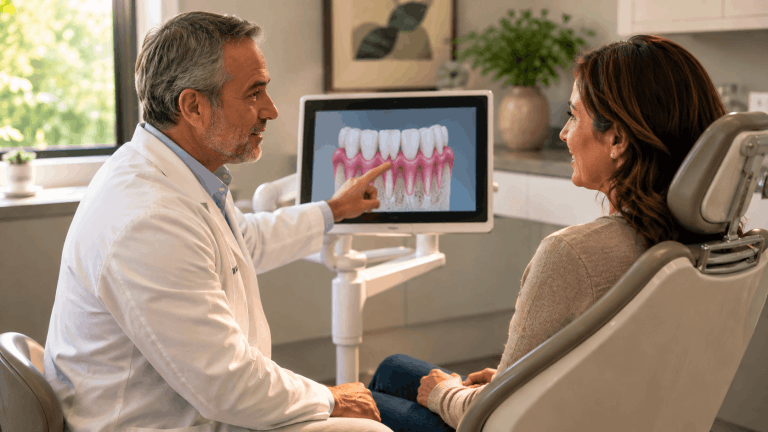
I was asked this question by a patient yesterday. After examining their gums and measuring the pockets around their teeth, I recommended another deep cleaning. Their response is almost always the same.
“But I already had one a few years ago.”
It’s a fair question, but it’s based on a common misconception. Many people think a deep cleaning is a one-time fix, like replacing a filling or taking out an appendix. Unfortunately, gum disease doesn’t work that way.
What a Deep Cleaning Actually Does
A deep cleaning, also known as scaling and root planing, removes hardened plaque, bacteria, and infected tissue from below the gumline. It allows the gums to heal and reattach more closely to the teeth. It’s an excellent treatment — but it isn’t a cure.
Think of it like mowing your lawn. Just because you mowed it last month doesn’t mean the grass stops growing. Gum disease behaves much the same way. The bacteria that cause it are always present in the mouth. If they’re allowed to build up again, the infection returns. The American Academy of Periodontology confirms that periodontal disease is a chronic condition that requires ongoing management, not a single treatment.
Periodontal Maintenance After Deep Cleaning: What Determines If You Need It Again
The real question isn’t whether you’ve had a deep cleaning before. The question is what your gums look like today.
When Home Care Keeps Gum Disease Stable
Over the years, I’ve seen patients who maintained excellent home care after their deep cleaning. They brushed thoroughly, cleaned between their teeth every day, kept their maintenance appointments, and their gum disease remained stable for decades.
When Gum Disease Quietly Returns
I’ve also seen patients whose gums slowly deteriorated because life got busy. They missed cleanings, stopped flossing regularly, or simply developed more plaque than they realized. Their gums became inflamed again, pockets deepened, and another deep cleaning became the best way to stop the progression before teeth became loose.
How Age and Health Conditions Affect Gum Disease
Age also plays a role. As we get older, our immune systems change, medications can reduce saliva, arthritis can make brushing more difficult, and chronic medical conditions such as diabetes can make gum disease harder to control. The CDC’s data on periodontal disease shows this connection clearly, especially in adults over 65 and those managing diabetes. Even patients who are trying their best may need additional treatment.
The important thing to remember is that needing another deep cleaning doesn’t mean the first one failed. It means your gums need help again — the same way you’d expect to revisit periodontal maintenance for any chronic condition.
Why Ignoring the Problem Rarely Helps
Ignoring the problem rarely makes it better. Gum disease is often painless until significant damage has already occurred. By the time teeth become loose or abscesses develop, treatment becomes more complicated, more expensive, and sometimes impossible without tooth loss.
Periodontal Maintenance Is an Ongoing Commitment, Not a One-Time Fix
So, if your dentist recommends another deep cleaning, don’t think of it as starting over. Think of it as maintaining an ongoing health condition.
We don’t expect someone with high blood pressure to take medication once and be cured forever. Healthy gums deserve the same long-term attention — the ADA’s MouthHealthy resource has good patient-friendly reading on this if you want to learn more.
The goal isn’t simply to clean your teeth. It’s to preserve the bone that holds them in place so you can keep your natural smile for as long as possible. If you have a history of gum concerns, I suggest seeing your dentist for regular preventive checkups and cleanings to make sure you stay on the right track. If you want another opinion, please feel free to call me at 440-951-7856, and I will do my best to help you.
Key Takeaways
- A deep cleaning treats existing gum disease — it doesn’t prevent it from coming back.
- Bacteria that cause gum disease are always present in the mouth, so ongoing maintenance matters more than the first treatment.
- Home care, missed cleanings, and life changes can all cause gum disease to return.
- Age, medications, and conditions like diabetes can make gum disease harder to control, even with good habits.
- Needing a second deep cleaning doesn’t mean the first one failed — it means your gums need attention now.
- Untreated gum disease can lead to loose teeth, abscesses, and eventually tooth loss.
Frequently Asked Questions
How often do I need a deep cleaning?
There’s no fixed schedule that applies to everyone. It depends on how your gums respond to treatment and home care, how deep your pockets measure at each visit, and whether risk factors like smoking or diabetes are present. Some patients go decades between deep cleanings; others need more frequent periodontal maintenance.
Does needing another deep cleaning mean I have bad oral hygiene?
Not necessarily. Age, medications, arthritis, and medical conditions can all affect gum health even when home care is excellent. Gum disease is a chronic condition, not a reflection of effort alone.
Is a deep cleaning the same as a regular cleaning?
No. A regular cleaning removes plaque and tartar above the gumline. A deep cleaning (scaling and root planing) treats infection and hardened deposits below the gumline, where regular cleanings can’t reach.
What happens if I skip a recommended deep cleaning?
Gum disease is often painless in its early and middle stages, so skipping treatment can allow it to progress silently. Left untreated, it can lead to receding gums, loose teeth, abscesses, and eventual tooth loss.
Schedule Your Deep Cleaning Today
If you have a history of gum concerns or it’s been a while since your last periodontal evaluation, schedule a visit with Dr. Jeffrey Gross or call 440-951-7856 for a second opinion.
Jeffrey Gross, DDS, FAGD, is an Ohio-licensed general dentist with over 40 years of experience and a Fellow of the Academy of General Dentistry. He was on the staff of Case Western Reserve School of Dental Medicine and has placed and restored dental implants since the early 1990s. He practices at The Healthy Smile in Eastlake and Cleveland Heights, Ohio.